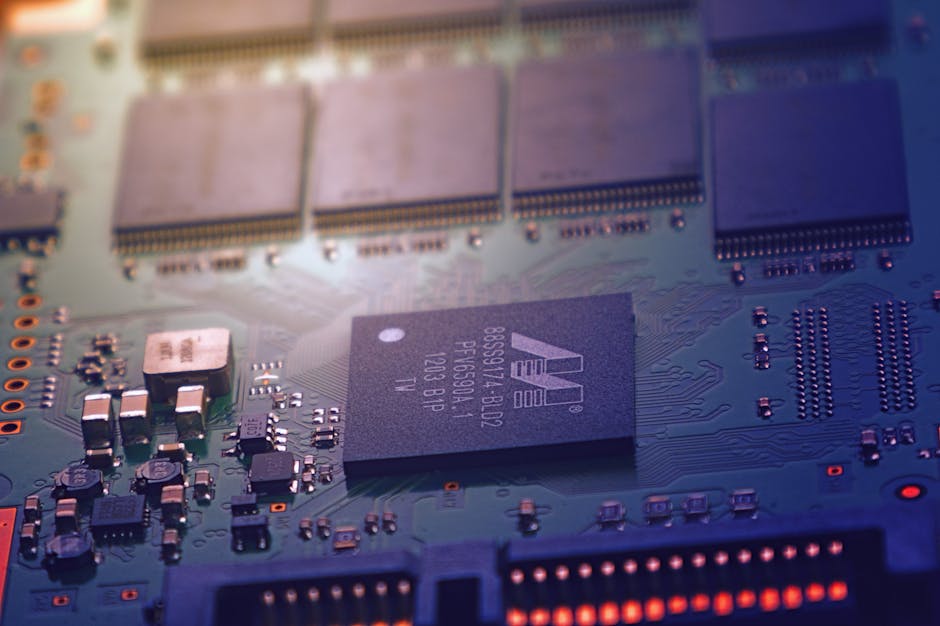
Photo by Johannes Plenio on Pexels
If you thought NVIDIA was merely the undisputed dragon sitting atop a mountain of glowing gaming GPUs, prepare to have your silicon-infused mind blown: the company is now teaching artificial intelligence how to design the very chips that make artificial intelligence possible, creating a delightfully recursive loop that should terrify every sci-fi screenwriter who ever warned us about Skynet.
The CUDA-X Family Grows Up
NVIDIA has announced that major semiconductor heavyweights are diving headfirst into its CUDA-X libraries—specifically featuring tools like cuPotential—to enlist AI agents for the grueling tasks of chip design and fabrication.
Let’s be honest for a moment. Designing a modern microchip makes putting together an IKEA wardrobe without the instructions look like a casual Sunday crossword puzzle. It involves billions of microscopic transistors that need to be arranged with the kind of precision usually reserved for Swiss watchmakers or, frankly, people who still choose to write heavy data science in R instead of Python (though we won’t judge your questionable life choices today).
Until now, human engineers did the heavy lifting, fueled by lukewarm coffee and existential dread. But human brains, wonderful as they are, tend to get tired after working sixteen-hour shifts. AI agents, on the other hand, don’t need sleep, don’t complain about office Wi-Fi, and certainly don’t care if you prefer wired earbuds over Bluetooth (though, for the record, true audiophiles keep a pair of both in their desk drawers).
Automating the Architects
By pushing CUDA-X deeper into fabs and design studios, NVIDIA is effectively giving the semiconductor industry an easy button.
Think of it this way: asking humans to design every single microscopic pathway on a next-gen AI accelerator is a bit like trying to build a modern skyscraper using only a pocketknife and a very optimistic attitude. It’s slow, it’s expensive, and someone always drops a beam. By letting AI agents tackle the heavy lifting of layout optimization and manufacturing flow, chipmakers can speed up innovation cycles faster than an Apple user upgrading to the newest iPhone—and yes, I admit iPhones are brilliantly engineered, even if I currently have three of them sitting in my gadget drawer right next to my collection of classic mechanical watches and sporty smartwatches.
The Recursive Future of Tech
What makes this move fascinating is the sheer irony of it. NVIDIA’s hardware powers the AI models, which are now being optimized by NVIDIA’s CUDA-X software, to design the next generation of NVIDIA hardware that will power even smarter AI models. It’s the circle of tech life, minus the Elton John soundtrack and with significantly more billions of dollars at stake.
As semiconductor fabs adopt these AI-driven workflows, the bottleneck of chip manufacturing might finally shift from human engineering limits to sheer computational brute force. And while we wait for our new AI overlords to finalize the blueprint for the ultimate processor, at least we can take comfort in knowing that charging our devices with a trusty, reliable wired cable will probably still take just as long. Progress has its limits, after all.
Source reference: blockchain_news
Disclaimer: This article was generated and formatted with the assistance of Artificial Intelligence.