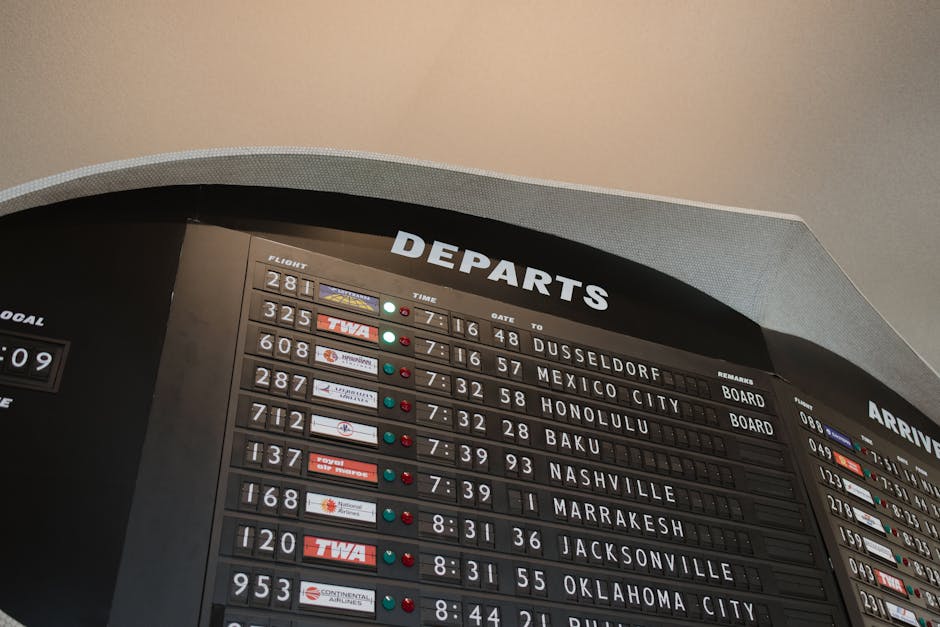
Photo by Josh Withers on Pexels
If you held a boarding pass anywhere in the United States this weekend, you likely spent your time staring at departure boards instead of sitting at your destination. More than 10,000 flights faced cancellations or delays on Sunday alone as carriers fought to recover from a massive network breakdown inside the Federal Aviation Administration. The disruption started Friday, November 13, 2026, when the agency ordered a nationwide ground stop that froze nearly every departing flight for almost five hours due to extraordinary circumstances, safety concerns, and serious communications failures. That five-hour pause stands as the longest total halt to American civil aviation since September 11, 2001.
The culprit was not an adversary, but routine hardware maintenance that went sideways. Transportation Secretary Sean Duffy explained on ABC’s “This Week” program that contractor L3Harris replaced a router at an FAA outpost in El Dorado, Arkansas. That swap triggered a malfunction in a recently installed router in Amarillo, Texas. The Amarillo device began broadcasting unchecked amounts of data across the air traffic control network, overloading routers at other control centers throughout the country and choking voice links. The agency stated that it disabled the originating routers alongside roughly 60 similar units across the network. Duffy noted there was no evidence of a cyberattack or malicious intent, adding that the technician who handled the installation was a veteran and patriot. Even so, the FAA still does not have the root cause for why a standard swap done thousands of times before broke the system.
Airlines spent Sunday taking unequal damage across their fleets. FlightAware tracked more than 2,300 outright cancellations and around 7,700 flight delays across the country on Sunday, following a brutal Saturday where carriers canceled over 6,400 flights and delayed more than 8,000. JetBlue took the heaviest hit on Sunday with 28 percent of its schedule cancelled. American Airlines grounded 17 percent of its trips. Delta, United, and Southwest absorbed the hit much better, holding cancellations between 3 percent and 5 percent. Duffy claimed that operations should improve Sunday and return to full normal service by Monday, November 16, but airlines are still moving crews and planes back into place.
By the raw numbers: 2,300 Sunday cancellations, 7,700 Sunday delays, 6,400 Saturday cancellations, roughly 60 FAA routers disabled nationwide, and one malfunctioning network node in Amarillo that briefly paralyzed an entire continent.
Watch whether Monday flight schedules fully normalize as Duffy predicted or if carrier operational backlogs spill into early week travel.
Source: The Daily Herald - Home
This article was researched and drafted with AI assistance.


